


Research Areas
Our research spans five areas of pure mathematics: algebraic and differential geometry, arithmetic dynamics, and the study of symmetries, structures, and their associated invariants.
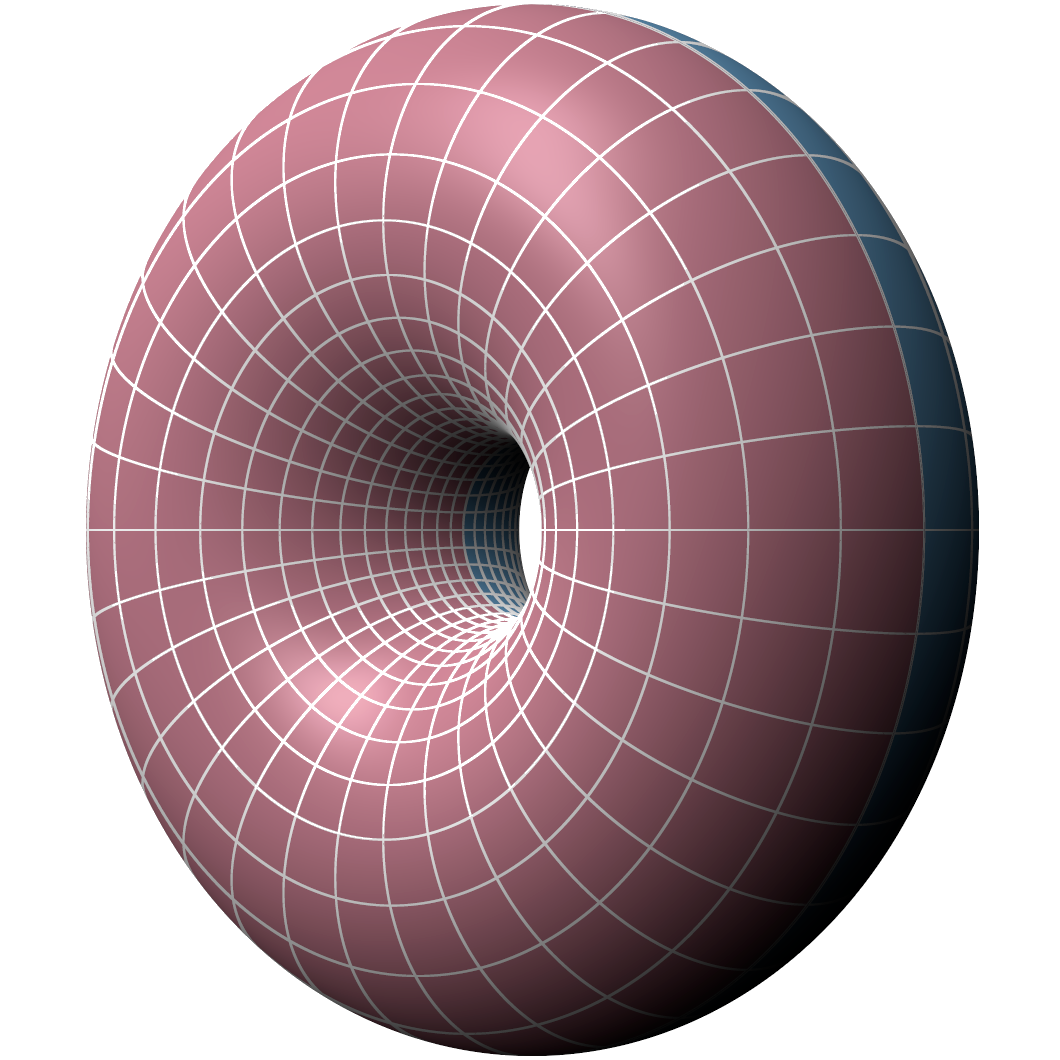 Torus · genus-1 abelian variety
Abelian Varieties
Complete projective varieties endowed with a group structure are called abelian varieties. Examples include Jacobian varieties — associated with compact Riemann surfaces — and Prym varieties.
The action of a finite group on an abelian variety induces an isogeny decomposition into abelian subvarieties of lower dimension, a decomposition strongly related to the irreducible representations of the group. We focus on the study of group actions on abelian varieties, with emphasis on the properties of the representations induced by the group action on relevant geometric objects.
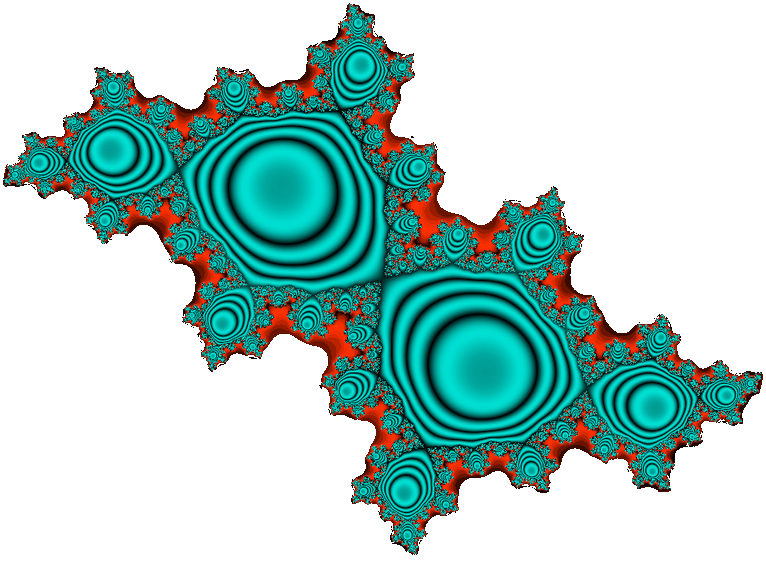 Mandelbrot set · iteration of rational maps
Complex Arithmetic
Dynamics
When the underlying Riemann surface is the Riemann sphere, an important object of study is the iteration dynamics of rational maps. Each rational map has an associated arithmetic invariant called its field of moduli (FOM). It is known that the field of moduli is a field of definition (FOD) for rational maps of even degree or for maps equivalent to polynomials (J. Silverman). For rational maps of odd degree this is not always true; however, our group has shown that there always exists a field of definition given by a quadratic extension of the field of moduli.
We are interested in understanding the FOD/FOM problem and, in particular, in describing Galois orbits of rational maps.
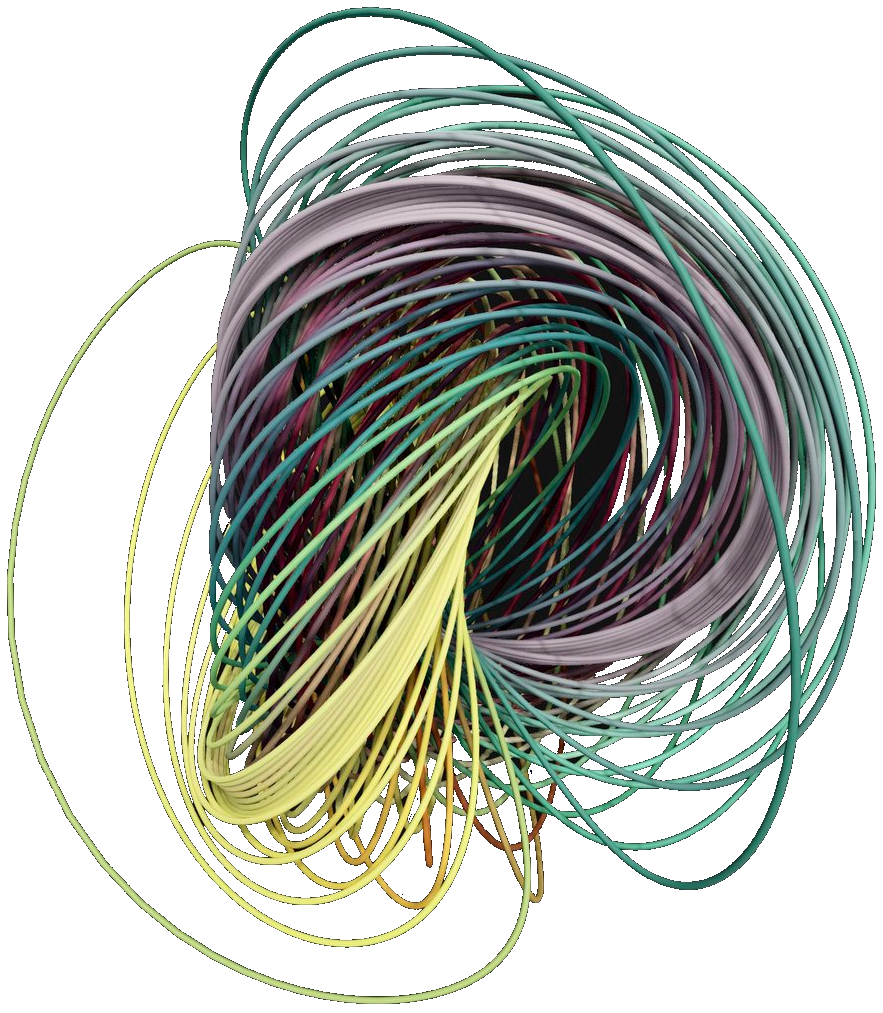 Geodesic flow · distributions and symmetries
Differential Geometry
Symmetries in differential geometry arise in two distinct ways: infinitesimally or globally. Infinitesimal symmetries play a central role in the study of k-plane distributions and are therefore ubiquitous in problems ranging from smooth foliations to geometric control theory, all closely related to the holonomy properties of the corresponding distributions. To study these symmetries, we draw extensively on methods from Lie theory and Lie algebras.
Global symmetries of a differential system can be encoded through additional geometric structures — often induced by metrics, differential forms, or related geometric data. Global symmetries naturally induce infinitesimal symmetries, while the latter, although conceptually simpler, rarely provide global information.
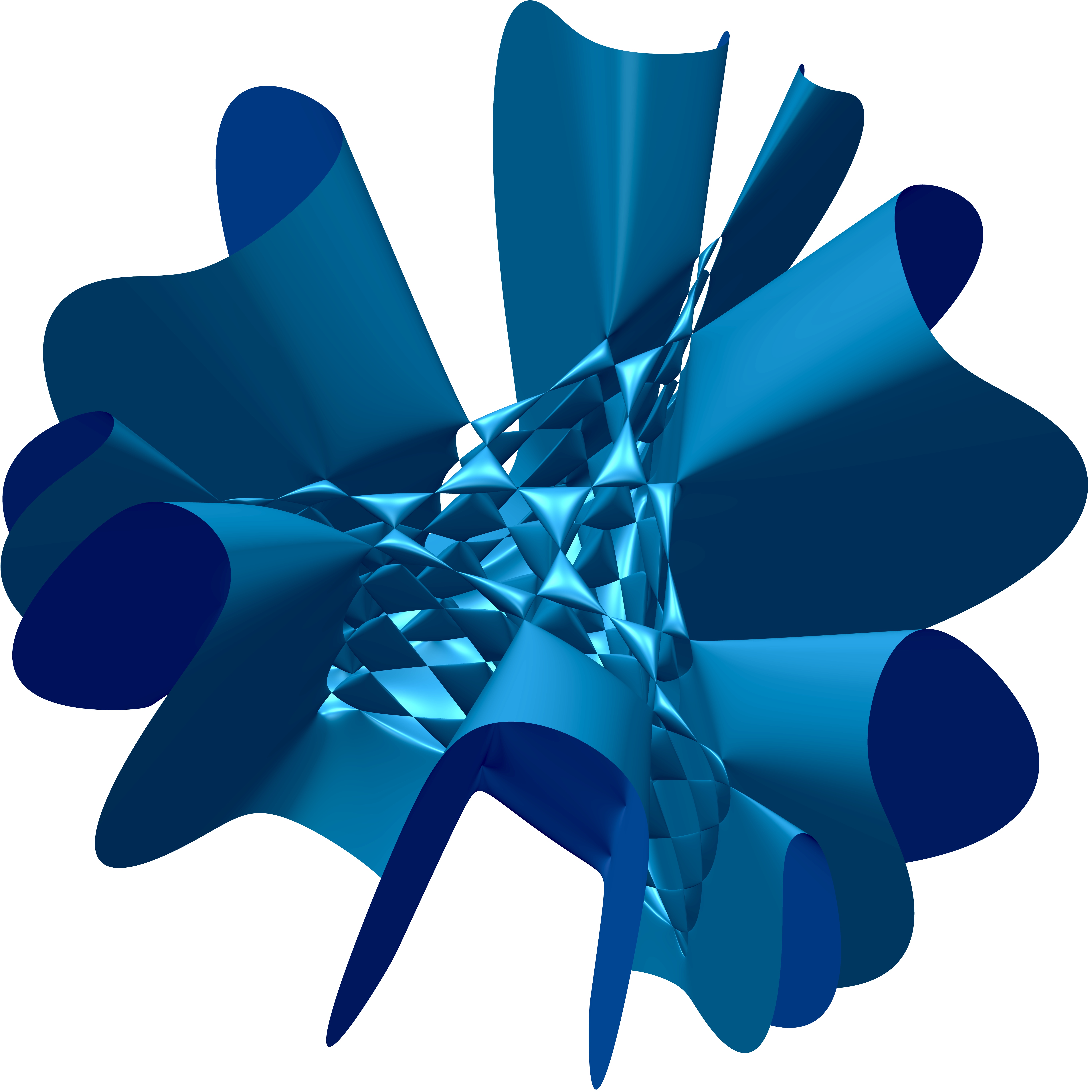 Algebraic surface · K3 geometry
K3 Surfaces
K3 surfaces are complex algebraic surfaces with an extraordinarily rich geometry, making them an active and important area of research in algebraic geometry. The study of their automorphisms provides a powerful tool for understanding the geometry of these surfaces.
We investigate K3 surfaces admitting symplectic automorphisms — automorphisms whose action on the holomorphic 2-form is trivial — as well as non-symplectic automorphisms, studying their invariants and moduli spaces. We are also interested in the natural higher-dimensional generalizations of K3 surfaces, such as irreducible holomorphic symplectic varieties and Calabi–Yau varieties, together with their automorphism groups.
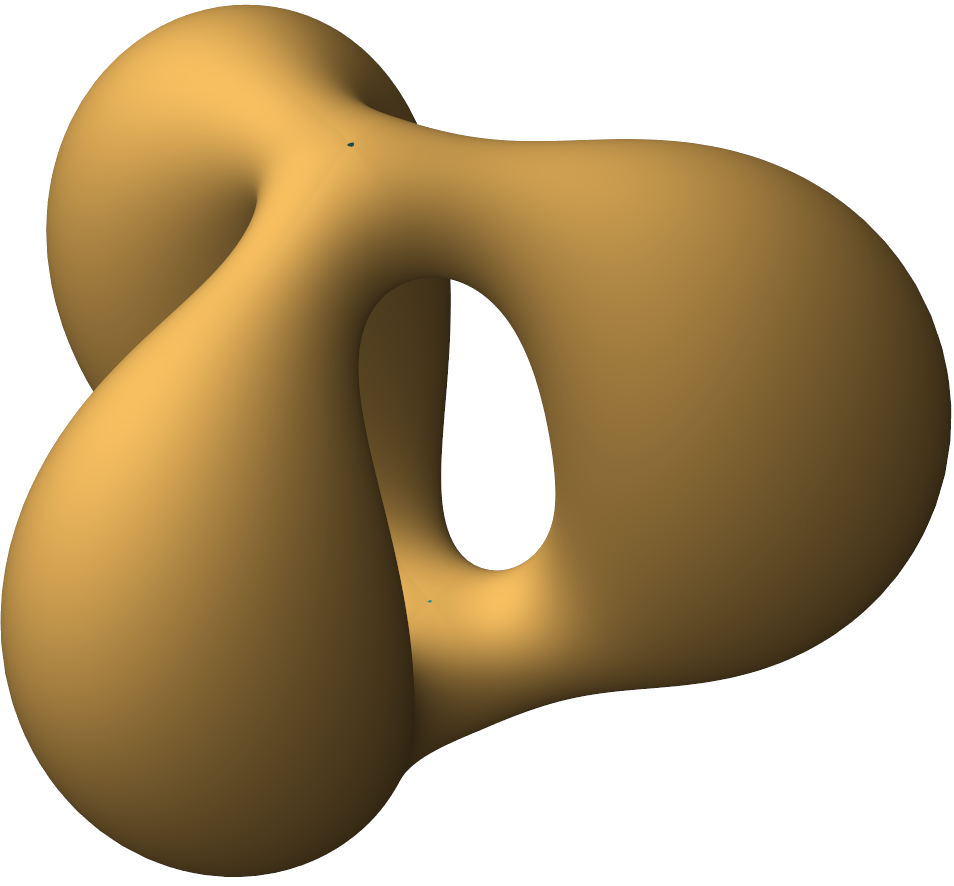 Genus-2 surface · compact Riemann surface
Riemann Surfaces
This area focuses on the study of symmetries, uniformizations, and algebraic aspects of compact one-dimensional complex manifolds, that is, Riemann surfaces. Only a small number of these objects possess non-trivial symmetries, and these give rise to the singular locus in moduli spaces.
Compact Riemann surfaces can also be described by complex algebraic curves and, in some cases, these curves are defined over the field of algebraic numbers. Such curves correspond to Grothendieck's dessins d'enfants and to Belyi curves. We study families of examples through algebraic invariants drawn from algebraic geometry, group theory, and combinatorics, and we are interested in describing minimal-degree extensions of the fields of definition over the corresponding field of moduli, as well as in studying new Galois invariants in the context of dessins d'enfants.